Undoubtedly, study abroad experiences play an important role in shaping students’ college outcomes (e.g., academic performance, satisfaction) and communication skills (Luo and Jamieson-Drake 2014). There is also a natural link between these experiences and employability (Curtis and Ledgerwood 2018). Importantly, I have found study abroad programs to also serve as wonderful tools for retention and recruitment. Through immersive international programs, students develop cross-cultural communication skills, global business awareness, and personal growth by working alongside peers, professionals, and local communities. My study abroad courses emphasize experiential learning through cultural immersion, applied business projects, service learning, and structured reflection. Whether traveling internationally or participating in virtual exchanges, students are encouraged to think critically about how place, culture, and technology shape consumer behavior, organizational practices, and their own perspectives as global citizens. Across these programs, students often discover new ways of seeing the world, and themselves, through learning that extends well beyond the classroom.

In 2026, I will lead a Study Abroad program to Japan for the third consecutive year. The experience combines cultural immersion, business engagement, and experiential learning across key locations such as Tokyo and Yokohama. Students explore sites including the National Museum of Emerging Science & Innovation, Tokyo Skytree, Shibuya, Harajuku, Sensoji Temple, the Tokyo National Museum, and Yokohama Chinatown, alongside activities such as a Japanese cooking class and guided cultural tours. Academic themes woven throughout the program include Japan’s manufacturing sector, supply chain innovation, company culture, and strategies for navigating the Japanese market. Students also complete a service-learning project in collaboration with a local University, connecting classroom frameworks to meaningful community engagement. WVU Abroad 2026 TripThrough this experience, students (1) gain a global perspective in business (e.g., Japan has a unique business culture deeply rooted in respect, hierarchy, and formality. Experiencing this firsthand can provide invaluable insights into cross-cultural communication—a critical skill in a global business environment), (2) learn about technological advancements (e.g., Japan is a global technology hub, known for its contributions to robotics, electronics, and automotive industries), and (3) gain personal growth and travel savviness (e.g., living in Japan allows us to immerse ourselves in a culture that values discipline, precision, and harmony. Adapting to a different lifestyle fosters personal growth, resilience, and the ability to thrive in diverse environments).
Japan: Tokyo, Kyoto, Hiroshima, Osaka
Brazil: São Paulo, São Luís, Santo Amaro, Rio de Janeiro
From 2019–2023, I led a 12-day study abroad program to Brazil focused on business, culture, and experiential learning across four distinct regions. Students learned directly from businesses, Brazilian peers, and local communities, gaining insight into how economic development, culture, and geography shape organizational practices. The program began in São Paulo, Brazil’s financial and cultural hub, where students engaged with established firms and startups while exploring the city’s artistic and architectural landscape. We then traveled to São Luís, a historic northeastern city known for its colonial architecture and Portuguese influence, before continuing to Santo Amaro in the Amazon region, where students experienced the unique environmental and cultural context of Lençóis Maranhenses National Park. The experience concluded in Rio de Janeiro, where students examined tourism, urban life, and national identity in one of the world’s most iconic coastal cities. We visisted iconic Brazilian brands including Havaianas, Suzano, the Port of Itaqui, and Natura. Throughout this program, students developed cross-cultural awareness, adaptability, and a deeper understanding of how place, culture, and business intersect in emerging and established markets.
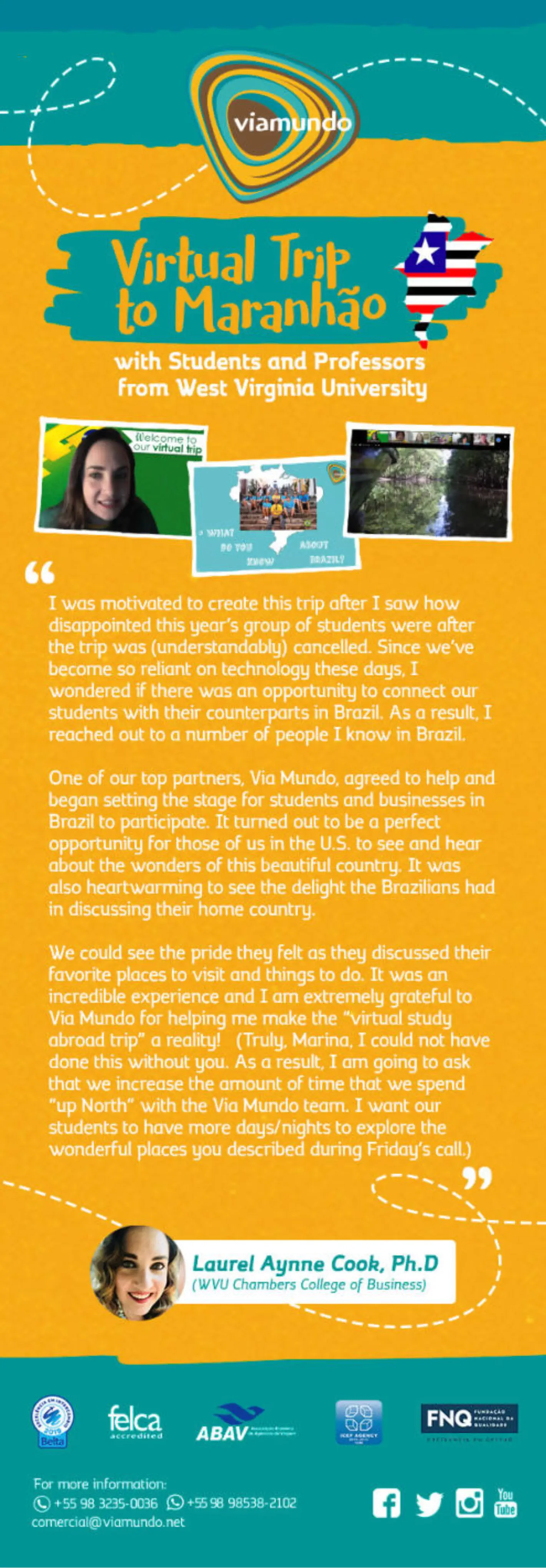
When in-person study abroad programs were canceled due to COVID-19, I developed a virtual study abroad experience in collaboration with the Brazilian team at Via Mundo. At the height of the pandemic, there were no viable alternatives for international travel, making this virtual format not only necessary but also a novel approach to sustaining global engagement. The program connected students in the U.S. with Brazilian college students, business owners, and cultural educators through live, interactive Zoom sessions. Participants engaged with visual presentations and discussion centered on Brazil’s culture, business environment, and key regions, including Lençóis Maranhenses National Park and the historic city of São Luís. Students and faculty were able to ask questions, exchange perspectives, and learn directly from Brazilian partners about daily life, local businesses, and cultural traditions.This virtual exchange created an unexpected but meaningful opportunity for global learning. Rather than serving as a substitute for travel, the program functioned as an innovative pedagogical model that broadened access to cross-cultural learning during a time of global constraint. Students gained insight into Brazil’s people and culture, while Brazilian participants shared their perspectives with pride and enthusiasm, reinforcing the value of reciprocal, globally connected learning even when physical mobility was not possible.
Study abroad experiences play a powerful role in shaping student success, communication skills, and career readiness. Through immersive international and virtual programs, students develop cross-cultural competence, global business awareness, and personal growth by working alongside peers, professionals, and local communities. My study abroad courses emphasize experiential learning, combining cultural immersion, applied projects, service learning, and reflection, to help students understand how place, culture, and technology shape consumer behavior, organizations, and their own perspectives as global citizens.
Japan: Tokyo, Kyoto, Hiroshima, Osaka
In 2026, I will lead my third Study Abroad program to Japan, blending cultural immersion, experiential learning, and business engagement in Tokyo and Yokohama. Students explore Japan’s business culture, technology leadership, and market strategies through site visits, applied projects, and a service-learning collaboration with a local university. The program emphasizes cross-cultural communication, global business perspectives, and personal growth, helping students build adaptability, global awareness, and confidence in diverse environments.
Brazil: São Paulo, São Luís, Santo Amaro, Rio de Janeiro

From 2019–2023, I led a 12-day Study Abroad program to Brazil, centered on business, culture, and experiential learning across four regions. Students learned from firms, local communities, and Brazilian peers in São Paulo, São Luís, the Amazon region near Santo Amaro and Lençóis Maranhenses National Park, and Rio de Janeiro. Across these settings, students developed cross-cultural awareness, adaptability, and a deeper understanding of how place, culture, and business intersect in both emerging and established markets.
Virtual Programs
When in-person study abroad was halted by COVID-19, I developed a virtual exchange with the Brazilian team at Via Mundo. The program connected U.S. students with Brazilian students, business owners, and cultural educators through live, interactive sessions focused on Brazil’s culture, regions, and business environment. Despite travel restrictions, the experience fostered meaningful cross-cultural learning, dialogue, and global connection for all participants.